
All About Fish
- Ksea Ocean

- Apr 26, 2022
- 3 min read
Fish consist of more than half of all vertebrate species and can be found in freshwater or saltwater. Scientists estimate that the ocean is home to over 35,000 different species of fish. Fish display numerous sensory innovations, respirate with gills, and their fins are precursors to tetrapod limbs. There are different classifications of fish, jawless, jawed, bony, ray, and lobe-finned fishes.


Tropical Reef Fish at Looe Key Reef, FL by Casey Pardue
Jawless Fish
Jawless fish have no jaws, scales, or paired fins. Two examples of these type of fish are the Hagfish and the Lamprey.
Hagfish are marine scavengers with rasping plates, feeding mostly on dead creatures. They lack vertebrate but posses a cranium, slime glands, and smell and touch senses.

On the other hand, Lamprey posses vertebrae. Some are parasitic, using the oral disc with teeth and a rasping tongue to capture their prey. They then inject an anticoagulant into wound which kills their prey. These fish caused the collapse of the lake trout fishery.

Evolution of Jaws and Jawed Fish
Jaws are modified cartilaginous gill arches. Diverging from jawless fish, jaws and gill arches have upper and lower bars that hinge and both arose from neural crest cells. Neural crest cells are unique to members of the vertebrates that arose from the embryonic ectoderm layer. There are about 1000 species of living-jawed fish that have been unchanged in the last 200 million years.

Class Chondrichthyes
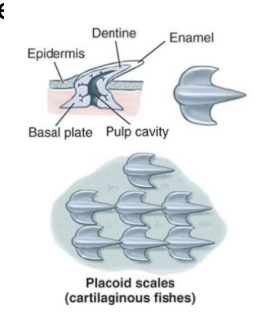
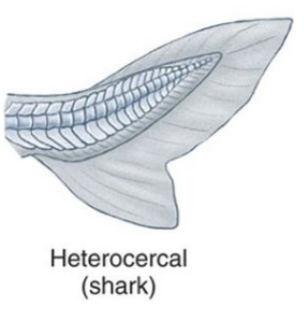
The Chondrichthyes class is one of my favorite classes, as it consists of sharks, rays, skates, and sawfish. These organisms are composed of a cartilaginous skeleton that is extensively calcified, but lacks bone. Their cartilage is composed of chondrocytes (specialized cells) that produce the collagenous extracellular matrix. The matrix contains calcium phosphate and collagen. Their bone relatively dense and they posses lightweight connective tissues. They have placoid scales which gives them a sandpaper-like feel, composed of enamel and vertebrate teeth which reduce the turbulence of water flow over the body. They have no swim bladder and maintain buoyancy via use of their fins and oil-filled liver. They posses a fusiform body with a heterocercal tail that provides thrust and lift, paired pectoral and pelvic fins, exposed gill slits, and teeth. Their lateral-line system can detect pressure waves and is composed of mechanoreceptors (neuromasts) that are arranged in a lateral line down the side of the body. Having excellent olfaction to smell and track their prey, they then use their vision to further track their prey at close range. Reproducing by internal fertilization, the pelvic claspers in males transfer sperm to females. There are three types of maternal investment, oviparity- where the animal reproduces by laying eggs, ovoviviparity- lay eggs but the mother keeps the eggs inside of her until hatching, and viviparity- where mothers give direct birth to their offspring. Some Chondrichthyes take part in intrauterine cannibalism or oophagy- egg eating.




Bony Fishes
The evolution of bony fish came about because the bone replaced cartilage developmentally. The embryonic cartilage became slowly eroded, which left large gaps for bone-forming cells to come in and take over. Bony fish differ from the classes prior to it because of the presence of mucus glands found in their skin. These mucus glands give the fish their slimy feel and it helps them to swim faster as the mucus reduces drag while swimming. The operculum or gill cover increases respiratory efficiency as it creates a pressure forcing water to be drawn across the gills. Bony fish have a present swim bladder and lungs- a gas filled pouch off of the esophagus that increases buoyancy.

Ray-Finned Fish
The ray-finned fish or teleosts are the biggest group of fish. These modern bony fish posses light and thin flexible scales that increase mobility and speed. Their unique scales also improve their predator avoidance and allows them to feed more efficiently. The homocercal (perched) tail permits greater speed. Their fins are supported by bony flexible rays. These new evolutionary changes shown by the ray-finned dish are useful for camouflage, braking, and communication.


Lobe-Finned Fish
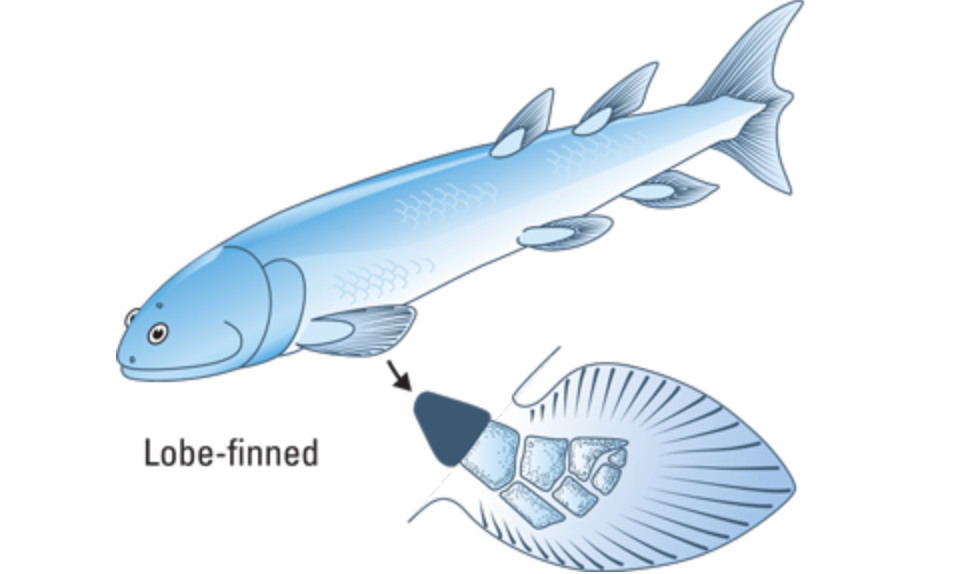
There are only 8 species of lobe-finned fish. The more known lobe-finned fish are the lungfish and coelacanth. Their fleshy lobe-like fins are supported by skeletal extensions that are moved by muscles within the fins. They can use their fins to "walk". They come to the surface to gulp air and breathe. This lineage gave rise to tetrapods.



Comments