
Echinodermata and Chordata
- Ksea Ocean
- Apr 21, 2022
- 3 min read
Updated: Apr 21, 2022
Introduction
The Echinodermata and Chordata phylum(s) are important due to their critical biological innovation of becoming deuterostomes. Deuterostomes are distinguished from protostomes based on their feature of embryonic development- the blastopore becomes the anus and display radial cleavage(vs. in a protostome the blastopore becomes the mouth and displays spiral cleavage). Consisting of 5 major classes- Asteroidea, Holothuroidea, Ophiuroidea, Echinoidea, and Crinoidea.

Phylum Echinodermata
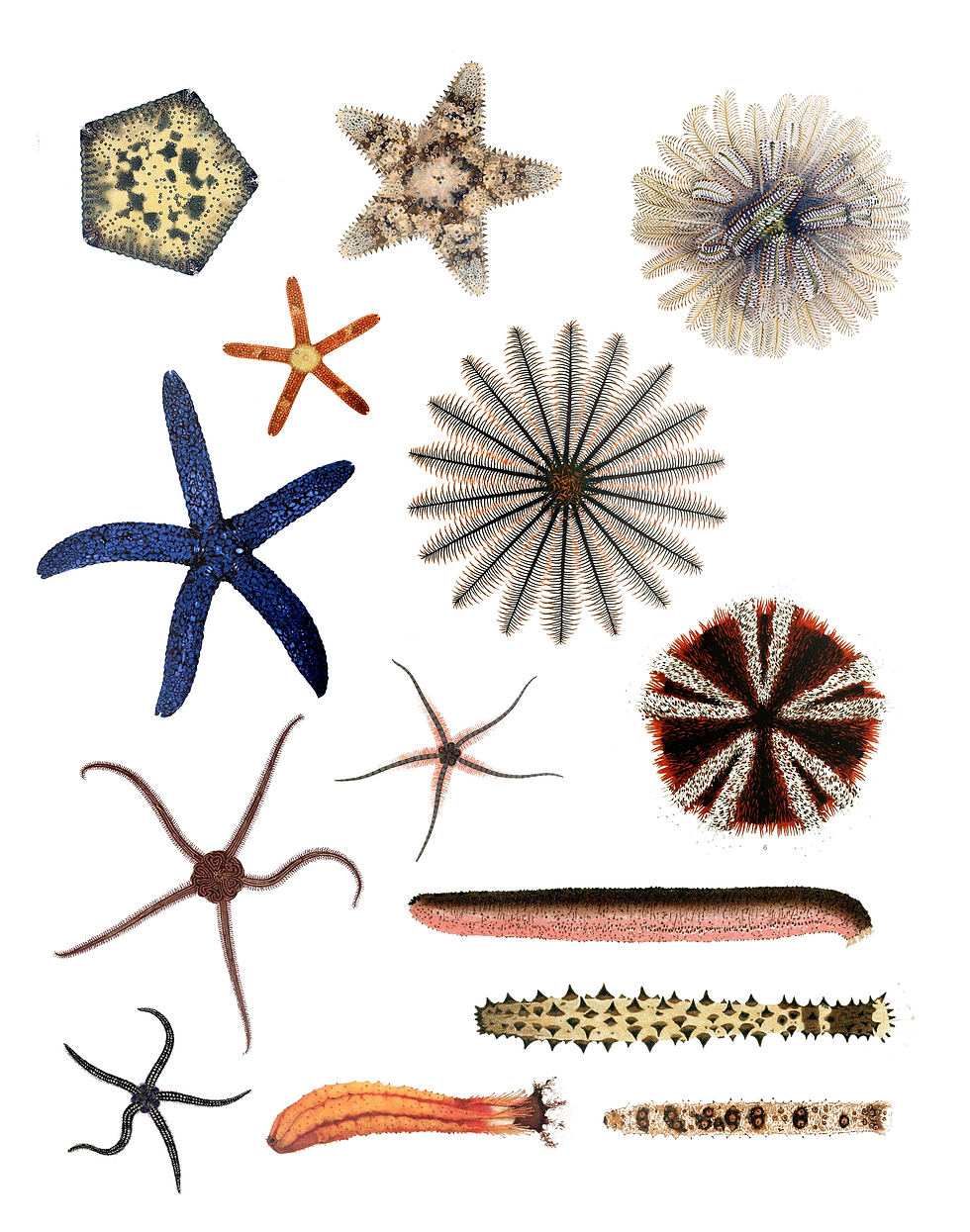
Echinoderms are all marine, including sea stars, brittle stars, sea urchins, and sea lilies. All free-living, these organisms have radial symmetry and no ability to osmoregulate.
Form and Function
- Central disc with 5 or more arms
-Rough and spiny Aboral surface
-Ambulacral groove (located on the oral side of each arm)
-Tube feet (podia) bordering the ambulacral groove and are protected by spines
-Endoskeleton made up of ossicles (provides rigidity and protection)
Aboral (Top) and Oral (Bottom) Sides


There are 5 General Traits of Echinoderms
Radial Symmetry (Bilateral Larvae)
Endoskeleton
Dermal Branchiae
Pedicellariae
Water Vascular System
The Endoskeleton
The endoskeleton is composed of ossicles. Ossicles are small calcareous elements embedded in the dermis of the body wall. Spines are specialized sharp ossicles that form the spiny surface. Providing rigidity and protection, ossicles composed of microcrystals of calcite are arranged in a lattice form known as sterom, which is unique to Echinoderms.
The Dermal Branchiae
The dermal branchiae is thin, delicate, and covered with epidermis. It extends out through spaces between ossicles. Dermal branchiae aid in reparation and excretion of nitrogenous waste via diffusion.

Pedicellariae
Pedicellariae are small, claw-shaped appendages found on the aboral surface bearing moveable jaws which are moved by muscles.
Water Vascular System
The water vascular system in Echinoderms functions in locomotion, excretion, and food gathering. The madreporite is the external opening of the canal system, can be found on both the aboral and oral sides depending on the taxa. Ampulla are also present- podia with suckers and muscular sac. Echinoderms use hydraulic pressure for movement.
Reproduction
Sexes are separate of Echinoderms and fertilization is external. Using autonomy, organisms can readily regenerate their lost body parts.
Asteroidea Class
The Asteroidea Class consists of true sea stars and starfish. The madreporite is found on the aboral surface of these species. These organisms are star shaped with 5 radial arms.

Holothuridea
This class consists of sea cucumbers and sea pigs. With an internal madreportite, these organisms are cucumber shaped with no arms and no spines.

Ophiuroidea
Members of the Ophiuroidea class have long, flexible arms that sharply radiate from a central disk. The madreporite is on the oral surface of these species. They have no pedicellariae and their tube feet lack suckers. Common examples include brittle and basket stars.

Echinoidea
The organisms of this class have a globe-like body composed of fused skeletal plates to form a test. Lacking arms, they have long, movable spines and tube feet extending around the sides of their bodies. Examples include sea urchins, sand dollars, and sea biscuits.

Crinoidea
This class consists of sea lillies and feather stars. They have feather-like arms that surround the mouth and tentacle-like tube feet for food collection. Having both polyp and medusa stages. They lack spines, madreporite and pedicellariae.

Phylum Chordata
This single phylum includes tunicates, lancelets, fishes, amphibians, reptiles, birds, and mammals. This organisms display biological innovations such as bilateral symmetry, segmentation, and endoskeleton. All Chordates share 5 distinctive traits...
Notochord- Flexible rod, appearing first in the embryo, later to be replaced by vertebrae in most. It supports and stiffens the body, acts as a base for trunk muscles and provides an axis around which the vertebral column develops.
Dorsal Hollow Nerve Cord- Sits dorsal to alimentary canal
Pharyngeal Slits- Connecting pharyngeal cavity to outside, developed for filter feeding, then gills
Postanal Tail- Evolved for locomotion in water
Endostyle- Thyroid gland

Subphylum Cephalochordata
All marine, these organisms bury themselves in sand. All chordate traits are present in this phyla. They are bilaterally compressed, segmented trunk musculature and filter feeds using cilia.

Subphylum Urochordata
These organisms are marine and solitary but can form tunicate colonies. Possessing both sessile and pelagic forms, only larvae display all 5 chordate traits.

Subphylum Vertebrata
The vertebrate subphylum has evolved and this is shown by the adaptations of the living endoskeleton, pharynx, nervous system, and paired appendages.
Living Endoskeleton
Grows with body
Cartilage then bone
Pharynx
Increased respiratory function
Supports high metabolic rates
Nervous System
Evolution of new cell types (neural crest cells) promoted development of head and sensory organs
Paired Appendages
Pectoral and pelvic girdles and limbs
Originated for balance in swimming

Distinguishing Traits of Vertebrates
Vertebral Column- Notochord is replaced by a column of interlocking vertebrae
Cranium- Anterior end of the nerve cord forms a brain that is encased in a protective housing
Endoskeleton- Cranium and Vertebral column
Neural Crest- Embryonic cells that contribute to cranium development
Internal Organs


Comments